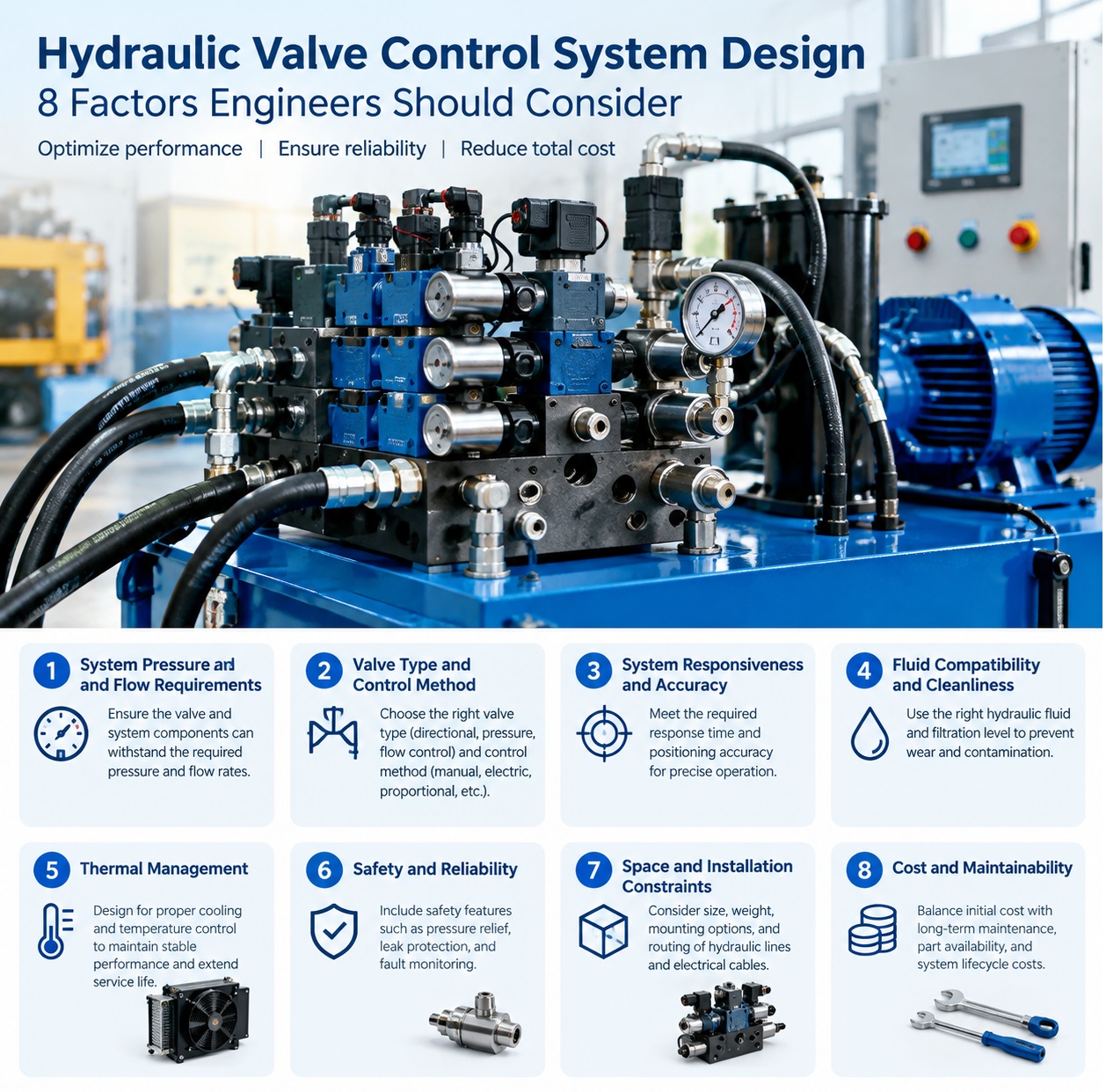
 A hydraulic valve control system rarely fails because the catalog looked good on paper. It fails because somebody ignored the ugly details. Flow forces. Deadband. Contamination. Heat. The difference between a machine that cycles a million times and one that leaks, sticks, or cooks its oil usually comes down to eight decisions made long before the first fitting is tightened. Here is what engineers should pressure-test during design, and where a good partner can save months of guesswork.
- Duty cycle and dynamic response Not every valve needs to be fast. But if your machine needs 20 Hz response, you cannot pick a valve by pressure rating alone. Look at step response, settling time, hysteresis, and repeatability. A valve that looks fine on a spec sheet can lag badly under real load. Duty cycle also affects coil temperature, seal life, and spool wear. If the machine runs three shifts a day, the design must assume three shifts of heat and contamination. We model duty cycle with you so the valve is not the weak link after six months.
- Fluid cleanliness and contamination tolerance Clearances in servo and proportional valves are tiny. If filtration is not specified to the right ISO 4406 class, you are designing a failure schedule. Consider flush procedures, filter placement, reservoir breathing, and whether the system will be serviced in a dirty environment. Contamination tolerance is not a feature you add later. It is a design choice. A valve that survives a clean test bench may fail in a foundry, a mine, or a mobile machine where dust and debris are normal.
- Pressure and flow envelope, not just one point A valve rated for 350 bar and 100 L/min may not deliver both at once. Check pressure drop curves, flow coefficients, saturation, and return-line restrictions. The operating envelope matters more than the headline numbers. Ask for real curves, not marketing curves. If the system spends most of its time at low flow and high pressure, the valve may be fine. If it needs high flow at high pressure, the wrong spool can turn a controlled motion into a heat generator.
- Control architecture and command strategy On/off, proportional, servo, or digital axis controller? Each choice changes cost, tuning, and troubleshooting. Decide whether you need closed-loop position, force, pressure, or simple direction control. The wrong architecture can make simple motion expensive or precision motion impossible. A proportional valve with the right amplifier may beat a servo valve with the wrong feedback. Match the architecture to the job, not to the brochure.
- Feedback and sensing Without reliable feedback, control is guesswork. Position sensors, pressure transducers, load cells, and temperature sensors must match the control loop speed and the environment. Noise, drift, and wiring routing can wreck a good valve. Build sensor diagnostics into the architecture from day one. If the controller cannot tell the difference between a stuck spool and a bad sensor, every fault becomes a downtime mystery.
- Environmental and safety demands Mining, offshore, food processing, mobile equipment, and factory automation each punish valves differently. Vibration, washdown, temperature swings, EMI, and explosive atmospheres affect seals, coils, connectors, and electronics. Safety functions like redundant shutoffs, fail-safe positions, and safe torque off need to be designed in, not bolted on. A valve that works in a clean lab may be the wrong choice for a machine that runs outdoors in January.
- Energy efficiency and heat Throttling losses become heat. Heat degrades oil and seals. If your system spends most of its time holding pressure, consider load sensing, variable displacement, or regenerative circuits. A valve control system that runs cooler often lasts longer and needs less cooling hardware. That saves space, weight, and maintenance. Efficiency is not just a green claim. It is a reliability strategy.
- Serviceability, diagnostics, and lifecycle cost The cheapest valve at purchase can be the most expensive at 2 a.m. during a production stoppage. Look at spares, calibration, tuning software, error codes, and how easy it is to replace a coil or cartridge. Design for the technician who will maintain it. That is not charity. That is uptime. A system that is easy to diagnose gets fixed faster, and faster fixes protect your production targets.
The best hydraulic valve control system design is not a parts list. It is a set of trade-offs made with clear eyes. Bring the real constraints early: duty cycle, fluid, environment, controls, and maintenance reality. A supplier can sell you a valve. A design partner can help you choose the architecture, validate it, and get it into production without the usual trial-and-error. That is the difference between a system that works on paper and one that works on the floor.